Blog

BENEFITS OF REVENUE MANAGEMENT SYSTEM

If you’re running a hotel or Resort, availing the service of Booking Master’s Hotel Revenue Management Software is the best business decision you can make.

Revenue management basically involves forecasting demand, setting prices, and optimizing inventory to maximize revenue and profitability. Managing the Revenue effectively helps hotels and Resorts increase their occupancy, average daily rate (ADR), and revenue per available room (RevPAR). These are the key metrics that are used to measure their financial performance.

Benefits of Booking Master’s revenue management for hotels:

Features and Benefits of Booking Master’s Revenue Management System (RMS)

Demand Forecasting

Forecasting in the hotel industry involves predicting the future demand for rooms and other hotel services. This can help the Hotelier in making informed and well-calculated decisions in terms of price of service, staff management, and marketing strategies.

Reporting Tools

Booking Master’s RMS is equipped with top-notch Reporting Tools that provide valuable insights and assist in making financial or revenue-related decisions.

Boosts Revenue and Profitability

Booking Master’s RMS optimizes prices and inventory based on demand and competition. Thus, Hotels can maximize their revenue per available room (RevPAR) and overall revenue. RMS has the ability to automatically increase a hotel’s revenue.

Improved Occupancy

Booking Master’s Revenue Management System can help hotels improve their occupancy and average daily rate (ADR). This can be done by analyzing market trends, demand patterns, and competition. Based on the analysis hotels set prices and inventory levels that are in line with their guests’ willingness and ability to pay.

As a result, hotels attract more guests and increase their occupancy. This can lead to higher RevPAR, and this is the ultimate goal of Booking Master’s Revenue Management System.

Enhanced Guest Experience

Booking Master’s Revenue Management System can help hotels enhance their guest experience. Hotels can ensure that their guests are getting the best value for their money by optimizing prices and inventory using revenue management techniques.

For instance, if a hotel is experiencing low demand, it can reduce its prices and offer attractive packages to attract guests. On the other hand, if a hotel is experiencing high demand, it can raise the prices and offer exclusive packages to meet its high-end guests. By providing customized pricing and packages as per the guests’ needs and preferences, hotels can create a memorable and enjoyable experience for their guests.

Saves precious time

With Booking Master’s Revenue Management System, the Hotelier no longer has to manually input data and track performance metrics. She can focus on other aspects of running the hotel by focussing on Business Strategy. Booking Master’s RMS provides the Hotelier with accurate and up-to-date data that can help her in making informed decisions about pricing, promotions, and more.

Market Segmentation

Booking Master’s Revenue Management System helps in Market Segmentation. Through Market Segmentation Hoteliers group travelers based on their reason for travel and hotel preferences. Using Market Segmentation Hoteliers reach specific travelers better with personalized marketing materials, targeted pricing strategies, and customer-centric services.

Note: Parameters of Market Segmentation:

  • Length of stay patterns
  • Weekday vs weekend business
  • Booking lead time
  • Pricing sensitivity
  • Cancellation percentages
  • No-show ratios
  • ADR and RevPAR per segment

Rate level utilization

Booking Master’s Revenue Management System maximizes profits by limiting low-ADR rate plans, capping discounts, or applying selected blackout dates to specific rate plans or booking channels. 

Final Thoughts

Booking Master’s Revenue Management System is an all-in-one, easy-to-use revenue management solution for all types of Hotels and Resorts that will empower Hoteliers to quickly reach new levels of profitability. It helps in capturing the most valuable business and making an immediate positive impact on revenue and profitability.

Booking Master’s Revenue Management System delivers scientific pricing decisions at the room type and rate code level to drive optimal revenue performance.

Improve your ability to make strategic decisions in the Hotel Business and increase profits with Booking Master’s Revenue Management System.

Benefits of using WhatsApp Business API in Hotel Business

Today, effective communication plays a pivotal role for successful businesses and their customers. Nowadays, guests prefer to interact with the Hotel Team effortlessly using texts, images, and emojis. Hence, Messaging apps like WhatsApp, Facebook Messenger, etc., are the most preferred communication channels.

Hoteliers too need a quick and efficient way to communicate with their customers.

In order to satisfy Guest’s needs and build lasting customer relationships, Booking Master’s WhatsApp Messaging API is the perfect solution.

Rationale:  More than 2 billion customers from over 180 countries use WhatsApp regularly to stay connected. Clearly, WhatsApp Business API is gaining prominence.

Hotels can easily leverage WhatsApp to improve their communication with guests and drive more conversions.

Booking Master’s WhatsApp Integration Service

WhatsApp integration helps Hotels increase direct booking conversion rates by up to 112%. Hoteliers can leverage WhatsApp to drive effective guest communication and more lead conversions to generate high revenue in the Hotel Business.

Key features

✅ Improved Guest Communication

✅Automatic Greeting Message

✅Birthday and Anniversary Wishes

✅ Booking Confirmation Messages

✅ Check-in Messages

✅ Google Map Location sharing before Check-in

✅ Intercom Number, Restaurant Link, Special Dishes Messages post Check-in

✅ Sight- seeing offer Messages

The possibility of opening a WhatsApp message is 98 percent. This is five times higher than emails and SMSes. Additionally, it has a conversion rate of 45-60 percent, 12 times higher than the other two traditional communication channels. These statistics are significant and underscore the importance of leveraging WhatsApp.

Nowadays, online travel agencies (OTAs) like MakeMyTrip and Booking.com have now capitalised on this trend to drive more conversions and ensure a seamless guest experience.

Benefits of Booking Master’s WhatsApp Integration Service

WhatsApp can be used to remind guests that they are coming to stay at your Hotel/Resort. You can create a seamless experience by sending them a booking confirmation on WhatsApp, which reduces the hassle of guests going through their emails to find the booking voucher.

WhatsApp is a very effective tool for capturing abandoned bookings. There are high chances of witnessing significant conversions when the Hotelier sends personalized offers or discounts to potential guests who have quit their booking journey midway.

As a Hotelier, you can drive more upsells through WhatsApp on the day of arrival. More upsells equals more revenue.

Next, you can leverage WhatsApp by requesting for guest feedback on the day of departure. These would boost your customer reviews and also provide valuable insights.

Pre-arrival

Hoteliers can make use of WhatsApp to offer exciting upselling activities and other personalized services. 

  • Early check-in and late check-out
  • Room upgrades
  • Pickup services
  • Pet fees
  • Spa and wellness services
  • Breakfast buffet

Post arrival

Using WhatsApp upselling can be leveraged during the stay to offer various products and services.

  • Attractions and event tickets
  • Club facilities
  • Private dining room
  • Extended stays
  • Renting a bike/ car
  • Spa and wellness services

Post stay

While checking out, hotels can go the extra mile to impress guests with quality feedback. Hoteliers can offer guests a cab hiring service to the airport to ensure that guests leave with the best experience and hence give high ratings.

  • Airport/city transport and transfers
  • Discount vouchers for local businesses
  • Luggage room

Closing Remarks

Upselling with WhatsApp will help the Hotelier boost revenue, build customer loyalty, and smoothen operations.  With Booking Master it becomes extremely convenient to understand customer requirements and preferences. Remember, the right way to upsell is to utilize the right techniques and understand your customers. And Booking Master’s WhatsApp API integration does play a crucial role in this.  

Balancing Revenue And Demand In The Hotel Industry

In the Hotel Industry, Hoteliers should consider demand analytics as it is a crucial tool that can be used to determine pricing. In this context, seasonality (high and low seasons) plays a key role.  In the high seasons, due to high occupancy rates hotel room prices are not affected by the size of demand. But in low seasons, hoteliers tend to give incentives, lower prices give upgrades and upsell to overcome the drop in demand. Hence, the demand for rooms shows more responsiveness in the down-season. Other factors like the availability of rooms and the hotelier’s profit goals play a key role in this balancing act of Demand and Revenue.

Hoteliers can maximize revenue during high season by resorting to Booking Master’s Revenue Management Strategies. It’s important to take advantage of high demand, And Booking Master’s Revenue Management System can help Hoteliers with this by changing room rates based on analytics like historical data analysis, market trends, booking patterns, offering extra services and amenities, cross-selling and up-selling strategies, etc.

Revenue Management technique is used to predict consumer behavior at the micro-level. This analysis can be used to optimize pricing and maximize revenue growth based on demand.

In a nutshell, Booking Master’s Revenue Management System helps the Hotelier to sell the right Hotel Service at the right price to the right customer at the right time. Here, the Hotel Service can be anything starting from Room to Restaurant. It can be spa services, car rental services, tour guides, camping or laundry services.

Booking Master’s Revenue Management System aids in optimum utilization of the available resources, such as perishable inventory of hotel rooms depending upon the season.

This helps in generating the maximum amount of revenue from the business. It allows the management to make an informed and data-driven decision.

Other than Season, the demand for hotel rooms depends on various factors, such as the income level, preferences, and travel behavior of potential customers.

The availability and attractiveness of alternative accommodation options, such as Airbnb, and hostels also influence Demand. So, the goal is to increase demand during periods of low demand. There are various ways of doing this. Example: By attracting price-sensitive customers, such as vacationing families, with a price discount. Another revenue management tactic is to charge customers a lower rate if they stay over a longer period that also covers low-demand days. There are tons are such tactics that can be carfted for your Hotel by Booking Master based on the various parameters.

Booking Master provides simple revenue management solutions to hotels so that Hoteliers can make informed decisions and grow profits.

Every Hotel has its own strengths and weaknesses. Booking Master helps in identifying these and crafting methods that are most relevant to your needs specifically by taking a tailored approach through Revenue Management Software.

Booking Master’s Revenue Management System helps in predicting accurate demand forecasts and helps in anticipating seasonal trends and adjusting your revenue management strategy. It helps you upsell and cross-sell services effectively.

strategic marketing. The system helps you in creating Flexible Rate Structures that can help boost occupancy during the low season. It helps you in creating the right package for your guests that would entice them to choose your hotel.

Hire the best team to boost your hotel’s occupancy and maximize your revenue based on demand-supply analysis and guest behavior. Choose Booking Master’s Revenue Management System.
Benefits Of Booking Master’s Channel Manager

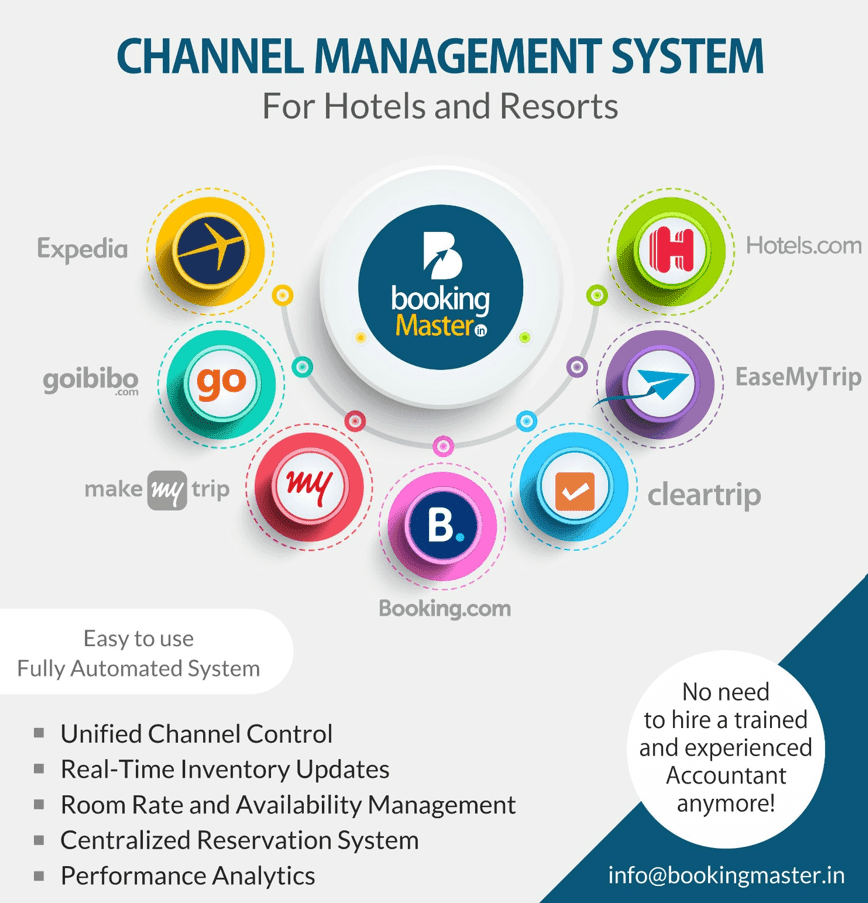
A ‘Channel’ is a third-party website. It is often referred to as an Online Travel Agent (OTA). These third-party websites allow users to search and book Hotel Rooms and Flights. These channels get into an Agreement with the Hotelier. As per this Agreement, they charge a fee for marketing your Hotel/ Resort and processing bookings on your behalf. In return, they charge a commission that was agreed upon. This Commission is usually a fixed percentage of the booking value, typically 10-20%.

Importance of Channels

OTAs can significantly increase distribution and therefore potential Hotel bookings. OTAs like Booking.com and Expedia control a huge proportion of all online hotel bookings. Even if your Hotel is a well-established brand with deep pockets, it is quite difficult to attract direct bookings through your Hotel’s Website. OTAs on the other hand, invest huge amounts of money just to attract large numbers of visitors to their websites. Since these OTAs show multiple properties visitors prefer these websites for their research as they do cross-comparisons before booking their accomodation. All you have to do as a Hotelier is to stand apart from other Hotels in this list of properties in terms of Ratings, Reviews and Services. OTAs play a major role in converting ‘lookers’ to ‘bookers’.

Decoding Channel Manager

Booking Master’s Channel Manager is a cloud-based application, that distributes your Hotel rooms, rates, and availability to all connected channels. For instance, your booking engine and OTAs.

When a customer makes a booking on any channel the channel manager updates rates and room availability across the rest of the channels automatically and on a real-time basis.

Working of the Channel Manager

When a room is booked by a channel manager pass this information in the form of Booking Data to the Hotel’s PMS i.e. Booking Master’s PMS. Once the reservation data is saved, the room is blocked. This particular information is now picked up by Booking Master’s Channel Manager who removes the room from the inventory across all channels on a real-time basis. This drastically reduces double bookings and unwanted overbookings for the hotel. At the same time, this allows the hotel to advertise its entire available inventory on all relevant portals.

Channel Managers give hotels some massive advantages. Your hotel’s reach is hugely increased through its presence on multiple platforms. This gives the Hotelier a greater opportunity of filling all the rooms. Channel managers also save an enormous amount of time and effort.

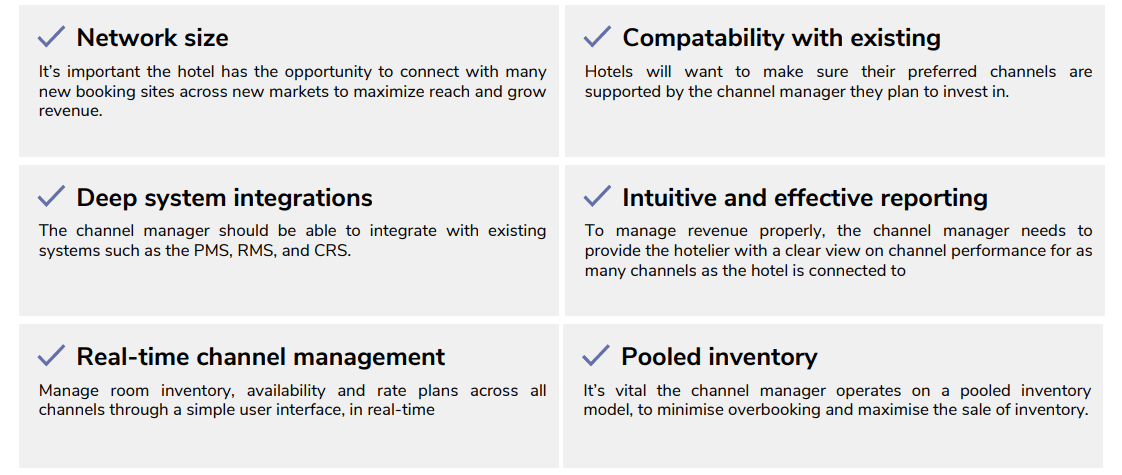
Thus, the benefits of using Booking Master’s Channel Manager are as follows:

  1. Hotel Rooms can be sold online across major online channels
  2. Inventory & rates are updated in real-time across multiple OTAs
  3. No more manual errors
  4. Minimize overbookings
  5. Reduce price parity issues
  6. Increase visibility
  7. Increase sales capacity
  8. Saves time
  9. Maximize profits


benefite_of_booking_master’s_channel_manager

Why choose Booking Master?

why_choose_booking_master


A channel manager could significantly boost your Hotel revenues and enhance the occupancy rate. Booking Master’s Channel Manager helps you track multiple channels from a single point. It helps you update multiple listings simultaneously through its two-way synchronization. A lot of time is lost in making adjustments to the listings one by one manually. Booking Master’s Channel Manager saves crucial time of the Hotelier that she can spend in other important things like Business Development. Double Bookings have a negative impact on Hotels’ revenue. Booking Master’s Channel Manager helps prevent overbookings and Double Bookings by updating the channels on a real-time basis. In a nutshell, Booking Master’s Channel Manager saves time and money by eliminating routine operations. Also, Booking Master’s channel manager increases the visibility of the Hotel on a national level.

Grow your Hotel Sales and Productivity with Booking Master’s Channel Manager Integration.

Boost your hotel revenue with Booking Master’s Marketing strategies

Introduction

An effective hotel marketing strategy can help you shine and stand out from the rest in the Hotel Business. You can employ a number of sales strategies to market and sell your hotel rooms. These strategies not only maximize sales but also ensure that the Hotel business is profitable at any given point.

In this article, we will pointwise highlight the best marketing methods and strategies used in the hotel industry/business:

Create Impactful content

Writing Blogs gives value to your potential guests. It is one of the best ways to drive traffic to your hotel’s website. In these blogs, promote the location and experience rather than just emphasizing lodging.

Powerful Hotel Marketing Campaign

Use content, ads, and other tactics to capture the attention and target people who are already interested in booking a hotel stay.

Local Marketing/Digital Promotion

Use digital tools such as websites, social media, search engine optimization (SEO) etc. to promote your Hotel room to local customers. Word of mouth is another important tool as it helps build trust with potential customers.

Search Engine Optimization (SEO)

Increase website traffic and build brand awareness by optimizing your website for search engines. SEO gives visibility to your Hotel and it fetches potential guests, to your Hotel website.

Chatbots

Chatbots build your Hotel brand’s reputation and help in conversions. It basically, increases communication, gives confidence to the visitor, and drives people down the Hotel booking process.

Use Social Media

Use social media platforms like  Facebook, Instagram, LinkedIn, and TikTok. Post pictures of your Hotel rooms and give updates to engage the audience.

Use Marketing Influencers

As a Hotelier you can entice many potential customers and persuade them to choose your Hotel by using an influencer who has a strong reputation and huge number of followers.

Build Credibility

Build a positive online reputation by getting feedback and reviews from previous visitors. This  “social proof” will drive Tourists to book your Hotel as they read reviews before reserving a hotel.

Data Analytics Tactics

Regularly track and analyze Hotel Booking performance by monitoring website traffic, conversion rates, traffic sources, and other relevant metrics. Make adjustments and improvements based on these findings.

Collaboration

Collaborate with event planners or companies as they design special rates, offers, and conditions for group bookings such as business travelers, wedding parties, conferences etc. They literally help in selling a larger number of rooms in one go.

WhatsApp/e-mail marketing

Drop personalized messages and emails containing special offers, and discounts to nudge potential guests and encourage them to book.

Re-marketing campaigns

Create personalized ads highlighting specific rooms/services/offers that typically align with the interests of potential customers.

Closing Remarks

There is no all-encompassing technique so the hotel sales strategy must be tailored to dynamic client requirements. The best way to outperform your competitors is to try various approaches to develop a brand identity and claim profitable outcomes in the changing Hotel business scenario.

WAYS TO ATTRACT REPEAT HOTEL GUESTS

“Profit in business comes from Repeat customers, Customers that boast about your service, and that bring friends with them” – W. Edward Deming.

Repeat customers are your loyal customers as they had a great experience with your brand in the past.

As per Reports, the chances of selling to an existing customer are 60% to 70%. However, the probability of selling a room to a new customer is only 5% to 20%. 

Tips to drive repeat Hotel business

  • Give customers a reason to come back with the quality of your service.
  • Run independent loyalty programs.  Offer rewards and incentives to customers who book multiple stays. These could be discounts on future stays, free upgrades, complimentary meals, etc.
  • Use Booking Master’s  Reputation Management Software to identify areas of improvement. With Booking Master, develop strategies to increase customer satisfaction.
  • Engage with customers on social media and provide personalized customer service.
  • Create a positive customer experience and this would automatically encourage Guests to return to the hotel.
  • Create and execute marketing campaigns that target existing customers.
  • Use valuable feedback from guests about their experiences. Make changes to ensure a better experience for future guests.
  • Ensure that you are seen by the right customers. Use Booking Master for this service.
  • Increase your hotel’s visibility and reach more potential customers. This can lead to more bookings and repeat business.
  • Offer rewards and discounts to returning customers.
  • Provide personalized services.
  • Create a memorable customer experience.
  • Offer the very best customer service. This can be done by training your staff on a regular basis.
  • When Guests have a problem, listen to them. Acknowledge their problem, and then offer them prompt solutions.
  • Customer service isn’t over, once your guests check out. Communicate after the stay. Give them an incentive to come and visit again soon.
  • Drop them a mail, or text your customers a thank you note, too.
  • To build trust, respond promptly and positively to both positive and negative reviews on online platforms.
  • Instead of a one-size-fits-all approach, adopt a tailored approach by analyzing guest preferences and past bookings. Create personalized deals specific to their interests.
  • Provide consistent, High-Quality service to your guests. Consistency is the key.
  • Send personalized greetings or offers to celebrate occasions like wedding anniversaries or birthdays.

“There is only one boss. The Guest. And he can fire everybody in the company from the chairman on down, simply by spending his money somewhere else”.

In a nutshell, having repeat guests is of immense importance as it can drive your hotel’s success. And the best way to attract repeat guests to your Hotel is to provide them with the best overall experience.

Use the above-mentioned tips to build guest loyalty. It’s crucial to create a strong network of happy customers to grow your hotel business.

Tips to choose the right Hotel PMS for your property

A Modern Hotel PMS helps in improving the guest experience, makes operations more efficient, and increases profitability.

With various PMS software available in the market offering multitudes of features, it is important to choose the right PMS for your Hotel/Resort.

Here are the tips to choose the right Hotel PMS for your property:

The right PMS for your Hotel should have the right mix of the following characteristics-

  • A simple and intuitive interface.
  • A fast and secure system.
  • A responsive and helpful support team.
  • A PMS that offers training.
  • A PMS that gets updated regularly.
  • The best PMS software will include Channel Management functions.
  • A PMS with Revenue Management functionality.
  • The PMS should be able to manage Customer Loyalty Schemes.
  • The best PMS software should be able to manage housekeeping tasks effectively.
  • Your hotel management software should include Automated Report Functionality.
  • A PMS that offers personalized guest services.
  • A PMS with customizable dashboards.
  • A PMS that seamlessly integrates with other hotel systems.
  • A PMS that offers mobile compatibility.
  • PMS that syncs automatically, keeping occupancy information updated.
  • The PMS must provide various payment options.
  • A live demo and trial period from the PMS provider.
  • A PMS with other essential systems, such as POS, CRM, online hotel booking engine, and channel managers.
  • Simplified folio operations
  • Security and stability
  • A PMS that automates all your hotel critical processes, from check-in and check-outs to invoicing and chargebacks.
  • Cloud PMS software as there is only a monthly subscription fee and there are no ongoing server maintenance costs.
  • A PMS that offers as close to 100% uptime as possible.
  • A property management system that secures and encrypts your hotel’s information.
  • Reports and insights so that the Hotelier can make data-driven decisions based on operational efficiency, revenue, and performance.
  • Services like inventory management.
  • A PMS that provides Services like Hotel Reputation Management.
  • A PMS with comprehensive reporting capabilities.
  • Ease of use is an important factor to consider while selecting a Hotel PMS.
  • A PMS with no hidden costs involved with maintenance and upgrades over time.
  • PMS with enhanced security measures such as encryption technology, password protection etc.
  • A PMS that is actively connected to a booking engine.
  • Your Hotel PMS should provide the possibility to create multiple price lists, special offers, early booking discounts, long stay discounts etc.
  • A PMS with simplified channel management that improves your property’s visibility by directly connecting to all the major OTAs.
  • A PMS that quickly adjusts room rates on all OTAs based on demand, room class, and occupancy percentage.
  • A PMS that manages reservations easily with all reservation information available at your fingertips.
  • PMS with the provision for easy upselling and cross-selling to generate more revenue.
  • PMS with a high-converting booking engine.
  • Integration with other software, such as door locking systems, cash drawers, guest communications, or self-check-in or check-out systems.
  • PMS with Website development tools
  • PMS with Online check-in and check-out capabilities
  • PMS with Guest communications and messaging tools.
  • PMS with demand management tools to set ADR, occupancy, and revenue goals, monitor performance against goals, and automate rate changes.
  • PMS that provides daily, weekly, and monthly, along with year-over-year comparison metrics and an easy-to-read overview of your property’s progress toward reaching your goals.

Tips To Increase Low-season Hotel Occupancy


Peak season is the best for the Hotelier as there is high demand and an influx of guests. During high season, it’s quite easy to achieve full hotel occupancy. However, the Hotel’s low season is a harsh reality of the global hospitality industry when the Hotelier has to struggle with attracting guests and reaching maximum hotel occupancy. Seasonality creates demand fluctuations that could be due to natural reasons, like temperature and climate. Also, other reasons, like holidays, economy and other factors play a role in this aspect. Unfortunately, low season has a negative impact on the Hotel’s revenue and turnover. Now, the question arises: How to increase demand outside high season

  • Use Booking Master to forecast low hotel occupancy periods with high accuracy.
  • This gives a crystal-clear picture of accounts receivable and payable during the low season. It enables the Hotelier to meet business objectives and do an overall planning.
  • Target niche markets: Focus on Millennials, backpackers and generations Z and X who travel throughout the year.
  • Make Wellness/Spiritual Travel a USP of your Hotel or Resort: Spiritual travel allows people to detach from the cacophony and get re-energized both mentally and physically.
  • Make your hotel pet-friendly, particularly during the low season as it will definitely help you attract customers who are otherwise reluctant to leave their pet during their trip.
  • Boost your occupancy rates in the low season with attractive family package deals.
  • Offer your property for corporate meetings and events during the low season.
  • Offer a coworking space for self-employed people and small businesses.
  • Create space for renting your property for weddings and other private events during the low season.
  • Focus on Geo-Targeted Marketing to increase conversions: For instance, if your hotel is situated in a coastal area, you could target potential customers from areas with high temperatures as they want to beat the summer heat.
  • Introduce new activities and offer lucrative Packages for potential guests.
  • Incentives like free drinks at the bar, welcome gifts, and huge discounts can attract customers in the low season.
  • Reduce room rates to attract price-sensitive customers.
  • Booking Master’s revenue management system can help you reach the right guests with the right offers during the low season.
  • Create engaging events for specific audiences during the low season. For instance, if you’ve decided to target retirees for a mid-week travel, you can hold an event where a local author speaks about financial planning during retirement.
  • Repeat guest promotions, event hosting, dine & and stay packages, value addition through special packages, concerts or dances, Spa packages & and retreats, complimentary airport shuttle etc. have the potential to attract guests.
  • Promote the low season as a benefit for the Guest. Highlight low room tariffs, great incentives, less crowds as unique selling points within your promotion.
  • Avail Booking Master’s Channel Management Service: The surest way to increase occupancy during the low season.
  • Temporarily increase your metasearch budget during the low season as there is a dip in occupancy at this time.
  • Increase your Google search engine ranking and optimize visibility by implementing effective SEO strategies, such as keyword usage and adherence to meta description guidelines.

In a nutshell, in order to stay ahead of competitors, you have to think outside the box during the low season. You need to consistently update and improve your Hotel’s Revenue Strategy and you can do that with Booking Master.

Applications of AI in Hotel Industry

Artificial Intelligence (AI) is rapidly transforming the Hotel Industry. AI can improve efficiency, increase revenue, and enhance guest experiences.

Applications of AI in Hotel Industry.

  • Personalised Guest Experiences.
  • Targeted services to guests based on their preferences and behaviors.
  • Predict equipment failures and maintenance needs.
  • 24/7 customer service with AI-powered chatbots.
  • Dynamic room price adjustment based on supply, and demand. Result:  Increased revenue and improved occupancy rates.
  • Optimisation of energy usage.
  • Facial recognition technology for check-in and security purposes.
  • Hands-free control over room features and services with AI-powered voice assistants, such as Amazon’s Alexa.
  • Automation of repetitive and time-consuming tasks.
  • Predictive and prescriptive analytics — improved ROI.
  • In-person customer service.
  • Artificial intelligence can help analyze consumer attitudes.
  • Sentiment analysis for better offerings to guests.
  • Real-time recommendations and a dynamic pricing structure.
  • Detection of the most effective distribution channels and adjust prices to appeal to specific customer groups.
  • Streamlining of Loyalty Programs.
  • Usage of customer data to curate personalized offerings for repeat guests.
  • Monitor the amounts and types of food purchased and consumption rates.
  • Predict requirements more accurately, avoiding waste and ensuring that ingredients don’t run out.
  • Predict the use of utilities such as power and water, tracking consumption and reducing costs here.  For example, in-room heating and air conditioning can be connected to the hotel’s PMS so energy isn’t wasted on unoccupied rooms.

Web App vs Mobile App: Key Differences to know

A Web Application (or web app) is application software that is accessed using a web browser. Web applications are delivered on the World Wide Web to users with an active network connection. Web Applications should not be confused with websites. Web Applications refer to any website that does some work for its users. On the contrary, Websites are mainly informative and a lot of documents can be accessed on websites over the Internet.

Mobile applications on the other hand are software programs that are built for a specific platform such as smartphones, tablets, and other touch devices. They are downloaded via the App Store (iOS) or Play Store (Android). Some popular mobile apps are Instagram, Zoom, Snapchat, Booking.com, and Spotify.

Web Apps Mobile Apps
Web Apps can be accessed directly using the internet browser. Users have to install the App on their device. They are installed via an app store such as Google Play Store and Apple Store
Web apps need an active internet connection in order to run. Mobile apps may work offline.
It can’t support complicated functionalities. It has Flexible User interfaces and it can support complicated functionalities.
Web apps will update themselves. The user needs to regularly download updates.
Web Apps are less expensive to develop. Mobile apps are more expensive to develop.
The speed of a Web Application depends on the quality of the internet connection. Poor connectivity leads to extended loading times. Mobile Applications give faster navigation with shorter load times by obtaining the system’s resources.
Web Apps don’t need to be approved by the app store. So, Quality and security are not always guaranteed. They are safe and secure as Mobile Apps must first be approved by the App Store.
User experience is inconsistent and dependent on the browser being used. User experience consistent.
Web Apps are slow and less responsive. Performance of Mobile Apps can be optimized to the device.